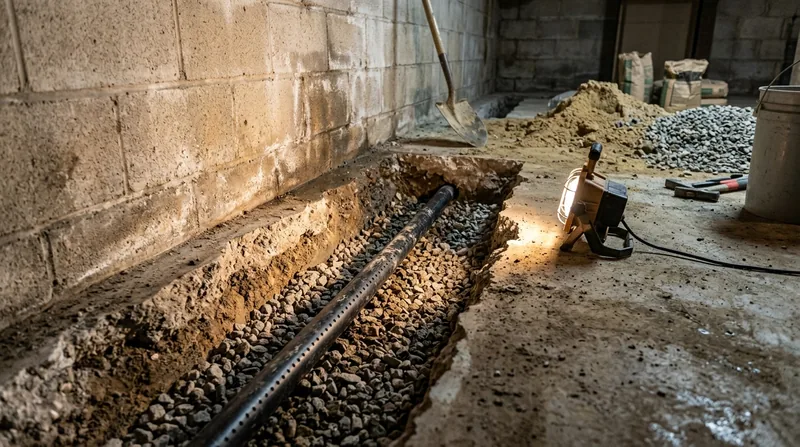




Vineland sits at the edge of the Pine Barrens in Cumberland County, laid out in the 1860s on former farmland, and that history is written into its basements. The older grid streets near downtown and Landis Avenue carry 1900s to 1930s houses with full basements under block or frame walls, often on fieldstone or early block foundations with clay tile drains that have been quietly failing for decades. East and south side Cape Cods and ranches from the 1940s to 1960s sit on block or poured walls, while newer edge subdivisions rest on graded sandy fill. The ground here is sandy loam and sand over clay, fast-draining in dry weeks but parked on a seasonal high water table, so long rain pushes groundwater up through joints and cracks. An Interior Drain Tile System in Vineland captures that water at the footing before it reaches your floor, and it works in any season. If you are still deciding between approaches, start with our basement waterproofing overview.
Why Vineland Basements Take On Water From Below
The dominant failure mode in Vineland is not a single cracked wall, it is hydrostatic pressure from a seasonal high water table sitting on top of clay. After a nor'easter or a tropical rain dump, water rises under the slab and finds the weakest point: the cove joint where wall meets floor, old clay tile drains that have collapsed or silted shut, and hairline cracks opened by freeze-thaw cycles in older masonry. Pooling in low yards pushes water laterally against the walls on top of that. Homeowners often see efflorescence or a musty basement smell first and assume it is a wall problem.
- Water seeps through the cove joint and floor cracks after two or three days of steady rain.
- Old clay tile footing drains in pre-war houses clog with silt and stop moving water.
- Sandy fill in newer subdivisions channels water fast toward the foundation during storm runoff.
- Spring runoff and nor'easter rain raise the water table faster than the soil can release it.
When the water is coming up rather than in through the wall, an interior perimeter drain is the honest answer, not another coat of sealer.
Key info: On a block-wall ranch off Chestnut Avenue, the floor stayed dry all summer and went wet every March. The wall was fine. The water table was the problem, and an interior drain tile system with a sump basin fixed it without touching the exterior.
For local code and permit questions on drainage work, check the City of Vineland's official site at vinelandcity.org and confirm requirements with the building department before work begins.
How We Install an Interior Drain Tile System in Vineland
We work from the inside, under the slab edge, so we are not digging up your yard, sidewalk, or landscaping. The sequence is the same on a 1920s block foundation near Landis Avenue as it is on a 1965 ranch off Sherman Avenue, only the wall material and footing depth change. We break and remove a channel of slab along the perimeter, excavate down to the footing, and lay perforated pipe in washed stone with a filter fabric wrap so silt stays out.
- We inspect the basement, check the cove joint and walls, and confirm the water is coming from below.
- We cut and remove a 12 to 16 inch channel of slab along the interior perimeter.
- We dig to the footing and set perforated drain tile in washed stone wrapped in filter fabric.
- We core and set a sump basin at the low point and tie the drain tile into it.
- We install the sump pump, check valve, and discharge line, then pour new concrete over the channel.
We finish by testing the system with water before we leave, so you see it move. If your existing drain tile is failing rather than missing, our drain tile repair and replacement service covers that path.
Key info: A 1950s Cape Cod near Vineland High School had water crossing the floor every spring. We ran interior perimeter drain to a sump basin at the low corner, tied in a battery backup, and the discharge line now kicks out past the downspout extension so it does not recycle back to the wall.
Interior Drain Tile Methods We Use
Not every basement needs the same configuration, and the right method depends on wall type, footing depth, and how the water behaves during a storm. Here is how the approaches compare on Vineland housing stock.
| Approach | Description | Best for |
|---|---|---|
| Full interior perimeter drain | Drain tile along the entire footing, feeding a sump basin and pump. | Widespread seepage at the cove joint and floor cracks. |
| Partial perimeter drain | Drain tile on the wet walls only, tied to a sump basin. | One or two walls taking water on a block or poured foundation. |
| Drain tile plus dimple board | Membrane on the wall directing water down into the drain tile. | Damp block walls and efflorescence above the cove joint. |
| Drain tile with battery backup | Sump pump with a battery backup on the discharge line. | Storm-season power outages when the water table is highest. |
| Targeted crack injection first | Epoxy or polyurethane injection on a single active crack. | One clear crack with no water table pressure behind it. |
We tell you plainly when injection is enough and when the pressure is coming from under the slab and only drain tile solves it.
Interior Drain Tile System Cost in Vineland: What to Expect
Interior drain tile pricing starts from $50 per linear foot, and that figure covers the channel, pipe, stone, and concrete patch. The real number depends on how many linear feet of footing you have, wall material, footing depth, whether we are adding a sump basin and pump, and how much floor has to come up. A 1920s block foundation near Landis Avenue with a shallow footing prices differently than a 1965 poured ranch on the south side. Getting two or three estimates is smart, because a quote that ignores the sump pump or the discharge line is not the same job.
For a full breakdown of what each component adds, see our pricing overview. We give you a written scope so you can compare line by line instead of guessing at a lump sum.
Choosing an Interior Drain Tile System Contractor Near Vineland
Hiring for below-grade work near Vineland means asking the same questions a homeowner in Millville or Bridgeton would ask. Confirm the contractor is licensed and insured, ask for the certificate, and call two or three references from jobs at least a year old. Get the scope in writing, including whether a sump pump, check valve, and discharge line are part of the price. Ask who pulls any permit, since work that alters drainage or the sanitary connection of a sump discharge commonly requires one and thresholds vary by jurisdiction. Verify with the local building department, and check HOA rules on discharge location before the crew arrives.
When you are ready to talk through your basement, reach us through our contact and free estimate page. We look at the water, not just the wall, and we tell you what the job actually needs.
Interior Drain Tile System in Vineland: Pricing Guide
| Service | Price | Details |
|---|---|---|
| Interior perimeter drain tile | Starting at $50/linear ft | Includes channel cut, perforated pipe, washed stone, filter fabric, and concrete patch. |
| Drain tile with sump basin and pump | Starting at $2,800 | Adds cored sump basin, pump, check valve, and discharge line tied to the drain. |
| Drain tile with battery backup | Starting at $3,600 | Adds a battery backup sump pump for storm-season power outages on the discharge line. |
| Partial perimeter drain | On estimate | Priced per wet wall after we confirm how far the water table pressure reaches. |
| Complex or large-scale job | On estimate | Deep footings, fieldstone walls, or floor obstructions need an on-site look first. |
| Estimate | Free | Response within 24h at (856) 416-6538, no obligation to book. |
Indicative pricing, the exact cost depends on square footage, finish, and site access. Free personalized estimate within 24h at (856) 416-6538.


