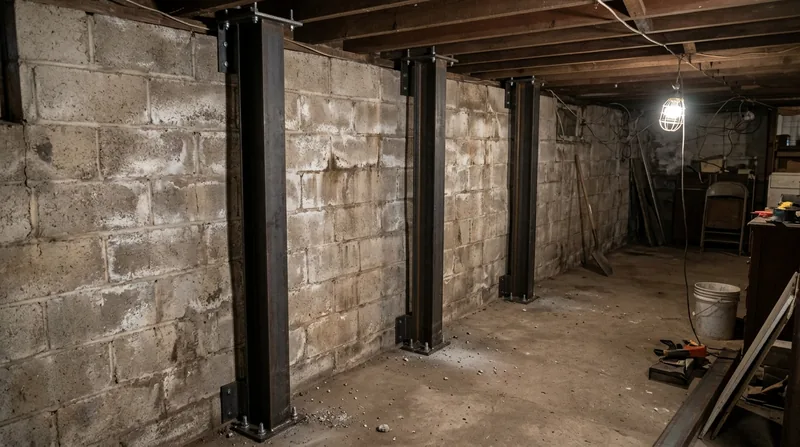




Bowing Wall Repair in Vineland is not a cosmetic fix. When a block or poured wall starts to lean inward, the soil behind it is already winning. Vineland sits on sandy loam and sand over clay at the edge of the Pine Barrens, and that profile drains fast in dry spells but holds a seasonal high water table after long rain. The 1900s to 1930s houses near downtown and Landis Avenue often carry full basements under early block or fieldstone walls, while the 1940s to 1960s Capes and ranches on the east and south sides have block or poured walls that have taken decades of freeze-thaw. We stabilize the wall, relieve the pressure behind it, and stop the movement before it reaches the floor framing. If you are already seeing water at the cove joint, start with our basement waterproofing service and we will tell you honestly whether the wall movement needs its own repair.
Why Vineland Block Walls Bow, and Why It Gets Worse After a Hard Winter
Hydrostatic pressure is the engine behind almost every bowing wall we open up in Vineland. The ground here is sand over clay, so rainwater percolates quickly and then stacks up on the clay layer, pushing saturated soil against the foundation. Older block walls were laid with soft mortar and no reinforcement, and freeze-thaw cycles open the joints a little wider every February. Once a wall moves past about an inch of deflection, it does not come back on its own.
- Clay tile drains from the 1920s and 1930s silt up or collapse, so footing water has nowhere to go and sits against the wall.
- Downspouts that dump within three feet of the foundation concentrate roof water right at the worst spot.
- Block walls laid in soft mortar crack horizontally at the mid-height course when the soil load peaks.
- Efflorescence and white powder on the interior face mean water is moving through the masonry, not just the paint.
- Grading that slopes back toward the house after a driveway or patio pour funnels surface water into the same corner.
Any one of those signs is worth a look, and two or more together mean the wall should be measured and monitored before another winter.
Key info: On a 1920s block basement off Landis Avenue, we routinely find a horizontal crack two or three courses down with visible inward lean at the top. That pattern points to soil pressure, not settling, and it is the case where carbon fiber straps earn their keep.
For the state side of the paperwork, the New Jersey Division of Codes and Standards publishes the model code framework that local building departments enforce, and Vineland's office has the final say on what a structural repair permit requires.
How We Diagnose and Repair a Bowing Wall in Vineland
We start by measuring the wall, not guessing at it. A plumb line and a laser level tell us how much deflection exists and where the pivot point sits, and we probe the soil behind the wall to see how wet it stays. Then we match the repair to the movement: a strap for a wall that has leaned an inch, anchors for one that has gone further or is still moving, steel for a wall carrying a floor load. We do not sell excavation when straps and drainage will hold the wall.
- We inspect the interior face, the exterior grade, and the footing drain condition, and we mark the crack pattern and deflection at each end of the wall.
- We relieve the pressure first, because a strap on a wall still being pushed is a bandage. That usually means correcting grade, extending downspouts, and confirming the drain tile is flowing.
- We excavate or work from inside as the method requires, then install carbon fiber straps, wall anchors, or steel I-beams at the spacing the deflection calls for.
- We seal the wall face and the crack with epoxy or polyurethane injection where water is active, and we restore the grade and parging.
- We re-measure the wall and leave you the baseline numbers so the next inspection has something to compare against.
The order matters: pressure relief, then structural restraint, then water control. Skipping the first step is how walls get re-repaired two years later.
Key info: A Cape Cod on the south side of Vineland had a rear block wall leaning 1.5 inches with a wet cove joint after every nor'easter. We anchored the wall, corrected the grade, and tied the discharge into a functioning drain tile repair rather than excavating the whole perimeter.
When the wall is stable but the basement still takes water at the joint, the better answer is often an interior drain tile system, and we will say so plainly instead of pushing anchors you do not need.
Repair Methods We Use and What Each One Is For
No single method fits every wall. The right choice depends on how far the wall has moved, whether it is still moving, and how much soil pressure is behind it. Here is how we sort them on a Vineland basement.
| Approach | Description | Best for |
|---|---|---|
| Carbon fiber straps | Straps epoxied to the interior face from floor to joist, tensioned to resist further inward movement. | Block walls with up to about 2 inches of deflection and no active water at the crack. |
| Steel I-beams | Vertical steel members set against the wall and anchored into the floor and joist system. | Longer walls with heavier soil load or where straps alone will not hold. |
| Wall anchors | Plates on the interior face tied through the wall to earth anchors set in stable soil outside. | Walls that have moved past 2 inches and need to be pulled back or held against active pressure. |
| Epoxy or polyurethane injection | Ports set along the crack, resin injected to fill the void and seal the masonry. | Hairline and shrinkage cracks in poured walls where water is the only problem. |
| Pressure relief and drainage | Grade correction, downspout extension, and drain tile or interior perimeter drain work to move water away. | Every bowing wall, because restraint without pressure relief is temporary. |
We combine these on most jobs. A strap or beam holds the wall, and drainage keeps the soil from loading it again.
Bowing Wall Repair Cost in Vineland: What to Expect
Pricing for a bowing wall starts at $600 for straightforward crack injection and sealing work and climbs from there once structural restraint is involved. The number that matters is the one after we measure the wall, because deflection, wall length, and access decide the method. A single strap on a short wall is a different job from anchors on a 30-foot wall with wet soil behind it. We give you the scope and the number in writing before any work starts.
- How far the wall has moved and whether it is still moving drives the method more than any other factor.
- Wall length and the number of straps, beams, or anchors needed set the material and labor line.
- Whether the soil behind the wall is staying wet determines how much drainage work has to come first.
- Access for excavation or equipment on a tight Vineland lot adds time and cost.
- Interior finishes that have to come out and go back in add a line most homeowners do not expect.
Get two or three estimates and compare the scope line by line, not just the total, because a low number that skips pressure relief is not a cheaper repair. Our full pricing overview shows how the pieces break down.
Bowing Wall Repair Near Me: How to Vet a Contractor Near Vineland
Structural work on a foundation is not the place to hire on price alone. Ask for the license and insurance certificate, confirm the company carries general liability and workers' compensation, and call two recent references who had similar wall movement. Ask each contractor how they will relieve the soil pressure, because the answer tells you whether they understand the problem. Then check whether the town requires a permit for the structural repair, since the rules vary and the local building department has the final word.
Permits are commonly required for structural foundation repair, and the threshold and inspection sequence differ by jurisdiction. A contractor who shrugs at that question is telling you something. We pull the permit when one is required and we schedule the inspection. Reach out through our contact page and we will walk you through what your address needs before we quote the job.
Bowing Wall Repair in Vineland: Pricing Guide
| Service | Price | Details |
|---|---|---|
| Crack injection and sealing | Starting at $600 | Epoxy or polyurethane injection on a poured wall crack, including port setup and finish cleanup. |
| Carbon fiber strap installation | Starting at $1,400 | Interior straps from floor to joist; price moves with wall length and strap count. |
| Wall anchors or steel I-beams | On estimate | Needs an on-site look at deflection, soil pressure, and access before a number is fair. |
| Drainage correction before restraint | On estimate | Grade, downspout, and drain tile work priced separately when the soil is still loading the wall. |
| Travel | Included | In Vineland and surrounding areas, no separate call-out or mileage fee. |
| Estimate | Free | Response within 24h at (856) 416-6538, no obligation to book. |
Indicative pricing, the exact cost depends on square footage, finish, and site access. Free personalized estimate within 24h at (856) 416-6538.


